

Complete Guide to Handmade Soap Ingredients for Beginners
Finding natural ingredients that truly support your skin and the environment can feel daunting. For eco-conscious British consumers, embracing handmade soap means gaining control over every aspect of your skincare routine. By learning how to select and combine essential herbal soap ingredients, you elevate sustainability and personalisation, crafting products that are gentle for your skin and respectful of the planet.
Table of Contents
- Step 1: Gather Essential Natural Soap Ingredients
- Step 2: Select Sustainable and Ethical Sources
- Step 3: Combine Ingredients for Desired Soap Properties
- Step 4: Tailor Formulas for Skin Types and Fragrances
- Step 5: Verify Quality and Purity of Final Ingredients
Quick Summary
| Key Point | Explanation |
|---|---|
| 1. Gather essential natural ingredients | Collect base oils, lye, water, and additives to create luxurious, skin-friendly soaps. |
| 2. Choose sustainable sourcing options | Prioritise organic, fair trade, and local suppliers to minimise environmental impact. |
| 3. Tailor formulas to skin types | Select specific ingredients that cater to different skin types for effective skincare. |
| 4. Verify ingredient quality meticulously | Conduct pH tests and perform quality checks to ensure soap safety and effectiveness. |
| 5. Document your soap-making process | Keep a detailed recipe journal to refine techniques and ensure consistent quality. |
Step 1: Gather Essential Natural Soap Ingredients
Welcoming homemade soap crafting means collecting a range of natural ingredients that transform ordinary oils into luxurious, skin-nourishing bars. Understanding the essential herbal soap ingredients allows you to create personalised, eco-friendly skincare products right in your own kitchen.
Your soap-making journey begins with gathering key components that form the foundation of natural soap production. Here are the essential ingredients you’ll need:
- Base oils: Coconut, olive, and castor oils
- Lye (sodium hydroxide)
- Distilled water
- Essential oils for fragrance
- Natural botanical additives
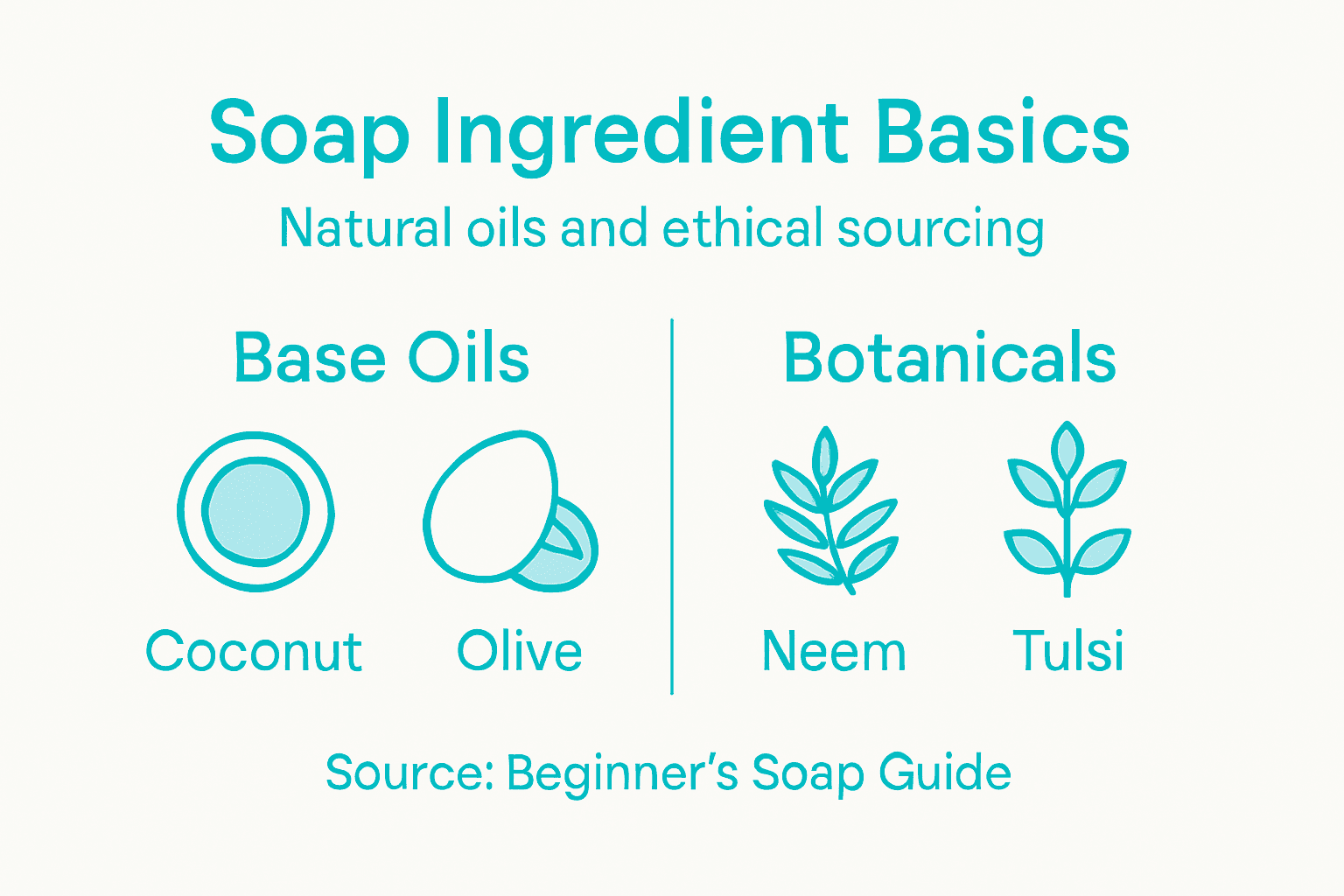
Each ingredient plays a crucial role in creating a gentle, nourishing soap. Base oils determine the soap’s cleansing and moisturising properties, while lye triggers the saponification process that transforms oils into soap. Botanical ingredients like Neem and Tulsi can provide additional antibacterial and skin-healing benefits.
Here’s a summary of how common base oils affect the properties of handmade soap:
| Base Oil | Key Property | Typical Skin Benefit |
|---|---|---|
| Coconut | Produces hard, lathery bar | Intense cleansing |
| Olive | Gives softness and glide | Deep conditioning |
| Castor | Increases lather stability | Soothes dry skin |
| Shea Butter | Adds creaminess and moisture | Enhances hydration |
| Avocado | Soft, gentle bar | Rich in vitamins |
Precision matters when measuring ingredients. Use a digital kitchen scale to weigh each component accurately, ensuring consistent soap quality. Protect yourself with safety goggles and gloves, as lye is a caustic substance that requires careful handling.
Pro tip: Source your ingredients from organic, sustainable suppliers to create the most environmentally friendly soap possible.
Step 2: Select Sustainable and Ethical Sources
Choosing sustainable ingredients is paramount when creating handmade soaps. Natural soap ingredients minimise environmental toxicity, ensuring your crafting process supports both human and ecological health.
When selecting your soap-making ingredients, prioritise sources that demonstrate genuine environmental commitment. Look for suppliers who provide transparent information about their ingredient origins, production methods, and ecological impact. Consider these key criteria for ethical sourcing:
- Organic certification
- Fair trade practices
- Minimal packaging
- Locally sourced ingredients
- Biodegradable components
Careful ingredient selection involves researching suppliers who align with sustainable principles. Seek out companies that provide detailed information about their agricultural practices, worker conditions, and environmental stewardship. Small-scale, local producers often offer the most transparent and responsible ingredient sourcing.
Ethical sourcing is not just about the product, but the entire production ecosystem.
Pay special attention to the environmental footprint of each ingredient. Some suppliers might offer carbon-neutral shipping, use recycled packaging, or support regenerative agriculture initiatives. These additional certifications can help you make more informed, environmentally conscious choices.

The table below compares sustainable and unsustainable sourcing choices for soap ingredients:
| Sourcing Type | Environmental Impact | Traceability |
|---|---|---|
| Organic/Local | Low pollution, supports eco-systems | Easily traced, direct sourcing |
| Non-organic/Imported | High chemical usage, long transport | Often unclear, complex supply chains |
| Fair Trade | Ethical, socially responsible | Transparent labelling |
| Uncertified | Potential exploitation | Limited supplier information |
Pro tip: Contact potential ingredient suppliers directly to request detailed sustainability documentation and verify their environmental claims.
Step 3: Combine Ingredients for Desired Soap Properties
Creating the perfect handmade soap requires understanding how different ingredients interact to produce specific characteristics. Soap formulation balances ingredient properties to achieve desired cleansing, moisturising, and aesthetic qualities.
The art of soap-making involves carefully selecting and combining oils, alkalis, and additives. Each ingredient plays a crucial role in determining the final soap’s performance:
- Base oils: Determine hardness and moisturising properties
- Alkali: Triggers saponification process
- Essential oils: Provide fragrance and potential therapeutic benefits
- Botanical additives: Enhance visual appeal and skin-nourishing qualities
Understand the unique properties of different oils and their fatty acid profiles. Coconut oil creates hardness and excellent lathering, while olive oil contributes softness and conditioning. Castor oil enhances bubble stability, and shea butter provides extra moisturising capabilities.
Precise ingredient combination transforms simple components into a luxurious skincare product.
Pay close attention to the ratios and interaction between ingredients. The temperature during mixing, precise measurements, and order of combination significantly impact the soap’s final texture, cleansing ability, and skin-friendly properties.
Pro tip: Create a detailed recipe journal documenting each soap batch’s ingredients and proportions to refine your technique over time.
Step 4: Tailor Formulas for Skin Types and Fragrances
Crafting personalised soaps requires understanding how different ingredients interact with unique skin types and preferences. Herbal soap formulations offer targeted skincare solutions by carefully selecting botanical extracts and essential oils.
Each skin type demands a nuanced approach to soap formulation:
- Sensitive skin: Gentle botanicals like Aloe vera and chamomile
- Oily skin: Neem and tea tree oil for balancing
- Dry skin: Shea butter and avocado oil for deep hydration
- Combination skin: Balanced blend of lightweight and rich oils
Consider the therapeutic properties of natural ingredients when designing your soap. Neem provides antibacterial benefits, while Tulsi offers antiviral protection. Essential oils not only contribute delightful fragrances but also deliver specific skincare advantages.
Your soap is a personalised skincare solution, not just a cleansing product.
Experiment with different oil ratios and botanical combinations. Start with small batches to test how ingredients interact and affect skin feel. Remember that fragrance intensity and skin compatibility are equally important in creating a truly bespoke soap experience.
Pro tip: Keep a detailed journal documenting each soap recipe’s ingredients, proportions, and skin response to refine your formulation technique.
Step 5: Verify Quality and Purity of Final Ingredients
Ensuring the highest standards of your handmade soap requires meticulous quality assessment. Physicochemical analysis guarantees soap safety and confirms the integrity of your carefully crafted product.
To verify ingredient quality and purity, focus on these critical evaluation parameters:
- pH testing: Ensures skin compatibility
- Total fatty matter (TFM): Measures soap’s cleansing potential
- Moisture content: Determines soap stability
- Foam stability: Assesses cleansing effectiveness
- Free alkali assessment: Checks ingredient balance
Consider investing in basic laboratory testing equipment or collaborating with local laboratories specialising in cosmetic product analysis. Simple home tests can provide initial insights into your soap’s quality, such as using pH strips, conducting lather tests, and performing visual and tactile assessments.
Quality control transforms your soap from a hobby project to a professional-grade product.
Pay special attention to potential contaminants and unexpected chemical interactions. Document your testing process meticulously, recording observations about texture, scent, lather quality, and skin response after each batch.
Pro tip: Create a standardised testing checklist to maintain consistent quality across all your soap batches.
Discover the Joy of Natural Soap Making with Pure, Ethical Ingredients
Embarking on your handmade soap journey means understanding the importance of selecting high-quality, sustainable ingredients that protect your skin and the planet. This guide highlights how essential oils, base oils, and botanical additives come together to create nourishing, eco-friendly soaps that suit every skin type. If you seek to move beyond theory and experience the benefits of expertly crafted natural skincare products, our Organic Personal Care Products range offers a perfect starting point.

Start crafting your personalised skincare routine with ethically sourced, natural ingredients. Embrace the harmony of sustainability and skincare today by exploring our selection and learn more about how pure, plant-powered formulations can elevate your self-care rituals. Visit The Soap Lab now and take the first step toward a cleaner, greener beauty routine with our Facial Care - Plant Powered Goodness collection designed to nurture and protect your skin naturally.
Frequently Asked Questions
What base oils should I use for making handmade soap?
To create handmade soap, consider using base oils such as Coconut, Olive, and Castor oils. Each oil contributes unique properties, like cleansing or moisturising benefits, so select oils based on the characteristics you desire in your soap.
How do I safely handle lye when making soap?
Always wear safety goggles and gloves when working with lye, as it is a caustic substance. Measure lye accurately using a digital scale and mix it with distilled water in a well-ventilated area to ensure safety during the soap-making process.
What are the benefits of using natural botanical additives in soap?
Natural botanical additives, like Neem and Tulsi, can enhance your soap’s antibacterial properties and provide additional skin-nourishing benefits. Incorporate these additives based on the skin types you aim to benefit, using around 5-10% of your total ingredient weight.
How can I ensure my handmade soap is of high quality?
Conduct quality tests such as pH testing and foam stability assessments to evaluate the final soap’s safety and performance. Create a standardised testing checklist to maintain consistent quality across all your batches.
How do I tailor my soap formula for different skin types?
To cater to various skin types, select specific ingredients that match their needs, such as Aloe Vera for sensitive skin or Shean Butter for dry skin. Experiment with small batches to find the right blend of oils and botanicals based on skin compatibility and personal preference.
What should I look for when sourcing sustainable soap ingredients?
Prioritise suppliers with organic certification, fair trade practices, and minimal packaging. Research their sourcing methods and environmental impact, and aim to use locally sourced ingredients whenever possible to reduce your soap’s overall ecological footprint.



